
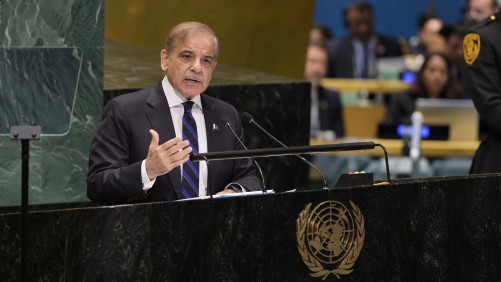
During a speech at the 81st session of the United Nations General Assembly, Pakistan Prime Minister Shehbaz Sharif highlighted the role of former US President Donald Trump in defusing a military standoff between India and Pakistan in May 2025. Sharif credited Trump with a “timely intervention” that helped prevent the escalation of the conflict between the two nuclear-armed neighbors. However, he also issued a stark warning regarding the Indus River waters, stating that any attempt by India to stop, impede, or divert Pakistan’s share would be considered an “act of war.”
Sharif emphasized the importance of avoiding similar confrontations in the future and praised Pakistan’s military response during the conflict, citing the nation’s right to self-defense under Article 51 of the UN Charter. Despite Sharif’s claims, India asserted that the ceasefire was achieved through direct bilateral communication, denying any third-party involvement.
Addressing the Indus Waters Treaty, Sharif criticized India’s decision to suspend the 1960 agreement, describing the Indus river system as crucial for Pakistan and the region. He argued that India’s actions lacked legal justification and stressed that international legal developments supported Pakistan’s stance on the treaty’s continued validity.
In response to Sharif’s remarks, India used its right of reply at the UN to accuse Pakistan of supporting cross-border terrorism, warning that such actions would have consequences. India reiterated its commitment to defending itself against terrorism and rejected Pakistan’s allegations, maintaining that repeated claims would not alter its stance on the issue.
The Indus Waters Treaty, a landmark agreement signed by India and Pakistan in 1960, governs the distribution and utilization of the waters from the Indus river system. The treaty has long been a source of tension between the two countries, and recent developments have further strained their relations.